Ask any operations head at a 50-plus store restaurant chain how they know when something is wrong at an outlet, and the honest answer, more often than not, is: the store manager calls, or they see it in the Monday report.
Both of those are fine systems. Until they are not.
The store manager calls when something is obviously wrong, a staff walkout, an equipment failure, a complaint that has already reached social media. What they do not call about is the slow drift: the 6% increase in food wastage over three weeks, the gradual decline in average ticket size during weekday lunch hours, the labour schedule that has been running 12% over budget because nobody updated it after the delivery mix changed.
These are not dramatic failures. They are quiet ones. And quiet failures at scale are expensive.
Margin Leakage Is Rarely One Big Problem
The restaurant industry works on thin margins. Food cost, labour, and occupancy together consume the vast majority of revenue. What is left — the 10 to 15% that a well-run chain might call EBITDA — is the product of hundreds of small decisions made well.
Which means it is also vulnerable to hundreds of small decisions made poorly, or not made at all because nobody had the information in time.
Consider a 70-store franchise network where three outlets are consistently underperforming on food cost by 2 percentage points. On a single outlet, that number is manageable. Across three outlets over six months, compounded with a labour variance issue that nobody flagged until the quarterly review, it becomes a meaningful hole in the P&L.
The problem was never the margin. The problem was the lag between when the issue started and when anyone with the authority to fix it found out.
Decisions Need Information, Not Just Data
There is a difference between having data and having the information you need to act. Most restaurant chains today have the former in abundance and are genuinely short on the latter.
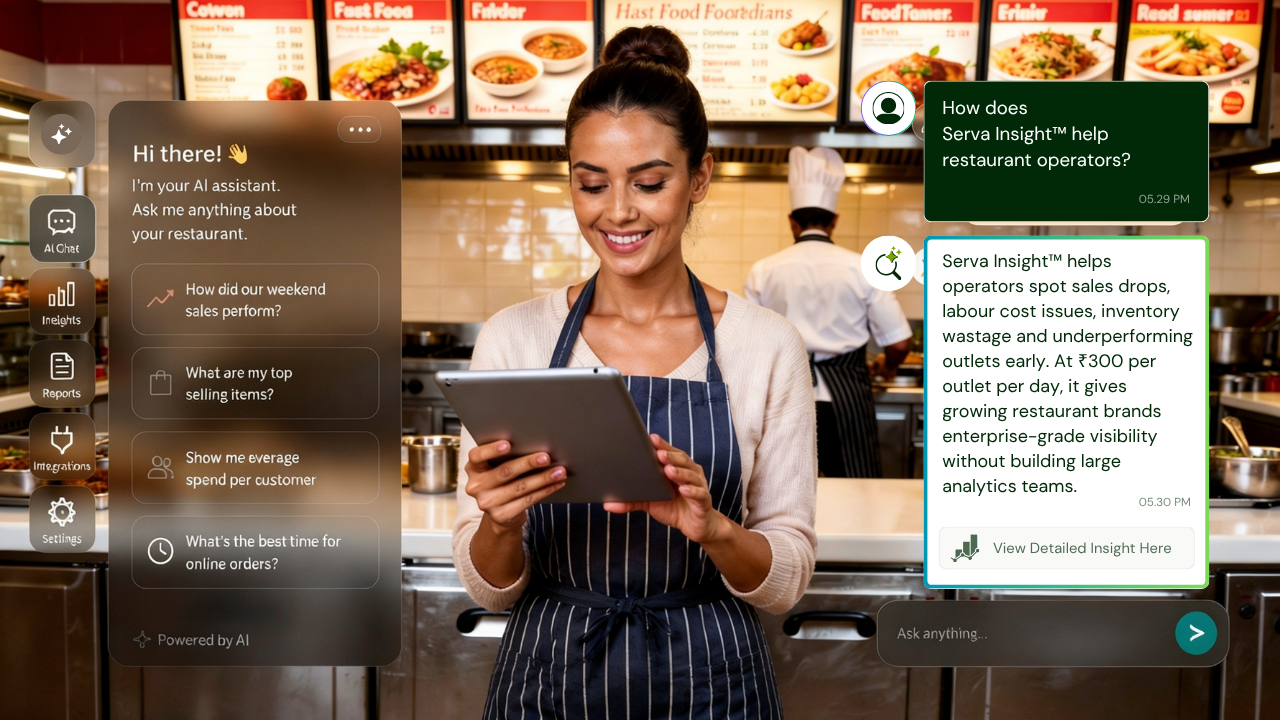
A well-run operation does not wait for reports. It has the ability to ask a specific question — why did our Pune outlet's average order value drop last week? — and get a specific answer that points to an action. Not a dashboard that requires interpretation. Not a spreadsheet that needs context. A clear, grounded answer that the operations head can do something with before the issue compounds.
As India's restaurant chains grow into new cities and new franchise structures, the ability to maintain operational visibility across every store, not just the flagship, not just the top performers, will increasingly determine who scales profitably and who scales into problems.
Gut feel built the first ten stores. Data-driven operations will build the next hundred.
Learn how real-time restaurant operational intelligence helps chains detect margin leakage early, identify outlet-level performance issues, and make faster data-driven decisions.



Ask any operations head at a 50-plus store restaurant chain how they know when something is wrong at an outlet, and the honest answer, more often than not, is: the store manager calls, or they see it in the Monday report.
Both of those are fine systems. Until they are not.
The store manager calls when something is obviously wrong, a staff walkout, an equipment failure, a complaint that has already reached social media. What they do not call about is the slow drift: the 6% increase in food wastage over three weeks, the gradual decline in average ticket size during weekday lunch hours, the labour schedule that has been running 12% over budget because nobody updated it after the delivery mix changed.
These are not dramatic failures. They are quiet ones. And quiet failures at scale are expensive.
Margin Leakage Is Rarely One Big Problem
The restaurant industry works on thin margins. Food cost, labour, and occupancy together consume the vast majority of revenue. What is left — the 10 to 15% that a well-run chain might call EBITDA — is the product of hundreds of small decisions made well.
Which means it is also vulnerable to hundreds of small decisions made poorly, or not made at all because nobody had the information in time.
Consider a 70-store franchise network where three outlets are consistently underperforming on food cost by 2 percentage points. On a single outlet, that number is manageable. Across three outlets over six months, compounded with a labour variance issue that nobody flagged until the quarterly review, it becomes a meaningful hole in the P&L.
The problem was never the margin. The problem was the lag between when the issue started and when anyone with the authority to fix it found out.
Decisions Need Information, Not Just Data
There is a difference between having data and having the information you need to act. Most restaurant chains today have the former in abundance and are genuinely short on the latter.
A well-run operation does not wait for reports. It has the ability to ask a specific question — why did our Pune outlet's average order value drop last week? — and get a specific answer that points to an action. Not a dashboard that requires interpretation. Not a spreadsheet that needs context. A clear, grounded answer that the operations head can do something with before the issue compounds.
As India's restaurant chains grow into new cities and new franchise structures, the ability to maintain operational visibility across every store, not just the flagship, not just the top performers, will increasingly determine who scales profitably and who scales into problems.
Gut feel built the first ten stores. Data-driven operations will build the next hundred.