What is inventory disposition?
Where sales and inventory planning decides what to buy, make and stock, inventory disposition decides what happens to the slow-moving and excess stock a business already holds.
Excess inventory is stock held above policy levels, such as minimum levels, reorder points and open commitments. Slow-moving inventory is stock that sells below set thresholds, such as no sales in six or twelve months. Thresholds vary by business, but both classifications drive reserves, so both affect the balance sheet.
Inventory disposition has two goals: recover the most value from that stock and stop more units from becoming slow or excess before the next reporting period.
What does it cost to hold excess inventory?
Many businesses default to holding. But holding is a decision too, and it costs money in four ways:
1) Carrying cost: capital, storage and handling. In HVAC and plumbing distribution, carrying cost often exceeds 25% of inventory value per year (Supply House Times, March 2026).
2) Aging: units cross age thresholds that trigger reserves and write-downs.
3) Closing windows: vendor return deadlines, supersessions and regulatory dates remove better options over time.
4) Opportunity cost: idle stock takes space from stock with stronger demand, especially when storage is tight.
The scale is significant. Research published by HARDI, the HVACR distributors’ association, found that 12 to 30% of hardline wholesalers’ inventory had not sold in over 12 months.
How can distributors clear excess inventory and how do the options compare?
Besides holding, hardware and equipment distributors can:
1) Transfer stock to a location with demand.
2) Match orphan components into complete systems.
3) Bundle slow items with fast movers.
4) Discount stock to clear it through normal channels.
5) Return stock to the vendor, within return allowances and windows.
6) Liquidate stock to brokers.
7) Scrap stock to free the space.
Each option should be judged on net recovery: what it brings in (price, credit or bid), less costs such as freight, handling, disposal and carrying cost. But options also clear stock at different speeds and with different certainty. When an option is both fast and high-value, the decision is obvious. More often, there is a trade-off (Figure 1).
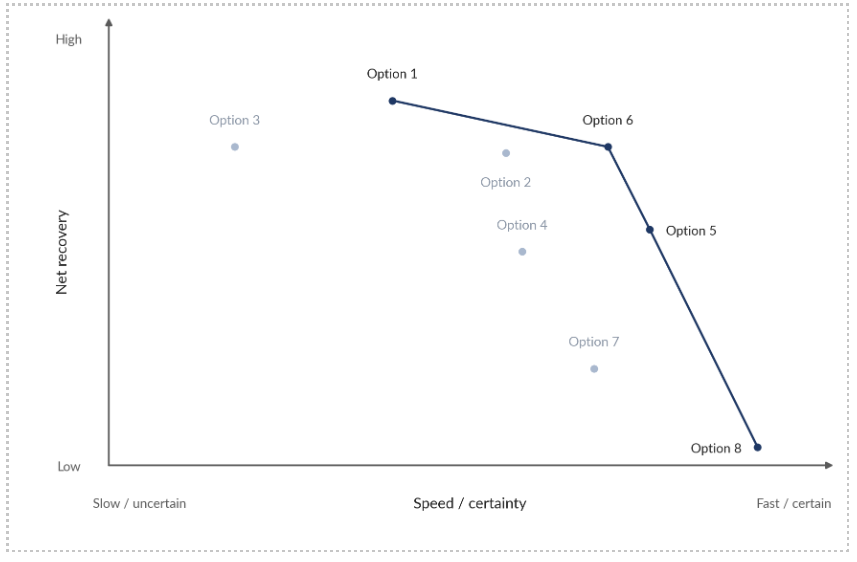
Scrap is fast but recovers little. Match-ups and vendor returns offer high value, but only when conditions line up: return allowances are limited and have strict windows, and match-ups need a compatible partner unit somewhere in the branch network.
Transfers cost freight and handling, and discounts clear stock only when they are deep enough. Seasonality matters too: air conditioning units and outdoor goods that are slow in winter may be worth holding until spring.
Example: one decision, several options (illustrative)
A distributor holds 400 units of a discontinued condensing unit across six branches, at a cost of $480,000. The vendor will credit 70% on up to 150 units if they are returned before 31 January. Two branches can sell 100 units at cost after a transfer.
The remaining 150 clear at a 40% discount. Together, these options recover $354,000, which is 74 cents on the dollar. Sending the whole lot to a liquidator would recover about 10 cents.
Why are inventory disposition decisions hard at scale?
Any one call, like the example above, is manageable. Thousands of them are not. Distributors often carry large SKU counts with low unit values and intermittent or seasonal demand. Each judgment needs demand forecasts that capture seasonality, cycles and trends; a view of stock and demand at other branches; and rules on whether, and how far, units can be discounted or bundled.
Decisions must also consider the whole portfolio. Decisions are made by product group, but some limits are shared across the portfolio, such as vendor return allowances and liquidation capacity. Scarce options should go where they gain the most over the next-best alternative: for example, return allowance to stock that would otherwise be scrapped, not to stock that could clear with a small discount.
How can AI help make disposition decisions?
AI helps most as part of a decision process built on unified data, where it estimates what is uncertain and surfaces the best options. Rather than one large optimization what works is a decision process configured to each business: its SKUs, options, constraints and operations.
The process must fit the business as the problem differs by business model. A multi-branch equipment distributor can rebalance stock across its network; a catalog distributor with one central warehouse often cannot. The catalog distributor publishes prices online, so it discounts through quotes and volume tiers rather than list-price cuts, and it must keep each part in stock to stay listed. Storage capacity, not carrying cost, is often its binding constraint.
Distributors often hold the data they need, but it sits in separate systems and must be unified first. This includes ERP inventory, sales and pricing; business events such as promotions, discontinuations and one-off project orders; vendor agreements; logistics costs and capacity; finance data such as carrying rate, reserves and loss budget; and disposition history. External factors matter too: end-of-life notices, supplier price changes, shortages, tariffs and regulatory dates can open or close options.
Unified data and business rules feed models that estimate uncertain inputs, such as how likely units are to sell within a time horizon and what each option recovers. The process then shows options by net recovery and speed, and flags opportunities such as match-ups and return windows as they open or close.
Where does human judgment fit?
Judgment still matters. Business context, such as storage pressure, product exits, working capital needs or an approaching period close, can make a faster option the better choice, even at lower recovery. Experienced executives understand that context and what the data does not show. AI sorts large volumes of data into clear options; executives set the time horizon, preferences and targets, and make the final call. Rules settle the many low-value decisions, and executives take the few high-value ones.
How can disposition help prevent future excess?
Disposition’s second goal, preventing excess, depends on feeding back into sales and inventory planning, including demand forecasts. Much excess is created at purchase, through minimum order quantities, case packs, volume rebates, buying ahead of price increases and vendor promotions. A good process shows which options delivered value and what shared limits cost.
It might show, for example, that an extra $10M return allowance would have recovered about $2M more: a useful insight for the next vendor negotiation. Product groups that keep falling into excess point back to stocking settings. Over time, disposition becomes as much about prevention as cure.
Frequently asked questions :
What is the difference between excess and slow-moving inventory?
Excess inventory is stock above policy levels, such as reorder points or minimum levels. Slow-moving inventory is stock that sells below a set threshold, such as no sales in six or twelve months. Both drive reserves and affect the balance sheet.
How much does it cost to hold slow inventory?
Carrying cost includes capital, storage, handling, insurance and shrinkage. In HVAC and plumbing distribution it often exceeds 25% of inventory value per year. Aging stock also triggers write-downs, and options such as vendor returns close over time.
What is the best way to clear excess inventory?
There is rarely one best option. Compare every option, from transfers and vendor returns to discounts and liquidation, on net recovery and speed, and use a mix across the portfolio. Scarce options such as return allowances should go where they add the most value.
When should a business act on slow inventory?
As early as possible, and before the next period close. The longer stock sits, the more it costs to carry, the more it is written down and the fewer high-value options remain.
Decide before the close
Every quarter that slow stock sits, it costs more to carry, its value falls and the better options close one by one. The best time to decide was when the stock first slowed. The next best time is before the books close.
At Findability Sciences, we build this decision process for distributors and manufacturers: unifying their data, configuring the options and rules for their business, and helping executives make the call across the whole portfolio.
Have excess inventory that is not selling? Holding it in the hope that demand returns costs money. So does disposing of it badly. How do you decide what to do across thousands of SKUs?




What is inventory disposition?
Where sales and inventory planning decides what to buy, make and stock, inventory disposition decides what happens to the slow-moving and excess stock a business already holds.
Excess inventory is stock held above policy levels, such as minimum levels, reorder points and open commitments. Slow-moving inventory is stock that sells below set thresholds, such as no sales in six or twelve months. Thresholds vary by business, but both classifications drive reserves, so both affect the balance sheet.
Inventory disposition has two goals: recover the most value from that stock and stop more units from becoming slow or excess before the next reporting period.
What does it cost to hold excess inventory?
Many businesses default to holding. But holding is a decision too, and it costs money in four ways:
1) Carrying cost: capital, storage and handling. In HVAC and plumbing distribution, carrying cost often exceeds 25% of inventory value per year (Supply House Times, March 2026).
2) Aging: units cross age thresholds that trigger reserves and write-downs.
3) Closing windows: vendor return deadlines, supersessions and regulatory dates remove better options over time.
4) Opportunity cost: idle stock takes space from stock with stronger demand, especially when storage is tight.
The scale is significant. Research published by HARDI, the HVACR distributors’ association, found that 12 to 30% of hardline wholesalers’ inventory had not sold in over 12 months.
How can distributors clear excess inventory and how do the options compare?
Besides holding, hardware and equipment distributors can:
1) Transfer stock to a location with demand.
2) Match orphan components into complete systems.
3) Bundle slow items with fast movers.
4) Discount stock to clear it through normal channels.
5) Return stock to the vendor, within return allowances and windows.
6) Liquidate stock to brokers.
7) Scrap stock to free the space.
Each option should be judged on net recovery: what it brings in (price, credit or bid), less costs such as freight, handling, disposal and carrying cost. But options also clear stock at different speeds and with different certainty. When an option is both fast and high-value, the decision is obvious. More often, there is a trade-off (Figure 1).
Scrap is fast but recovers little. Match-ups and vendor returns offer high value, but only when conditions line up: return allowances are limited and have strict windows, and match-ups need a compatible partner unit somewhere in the branch network.
Transfers cost freight and handling, and discounts clear stock only when they are deep enough. Seasonality matters too: air conditioning units and outdoor goods that are slow in winter may be worth holding until spring.
Example: one decision, several options (illustrative)
A distributor holds 400 units of a discontinued condensing unit across six branches, at a cost of $480,000. The vendor will credit 70% on up to 150 units if they are returned before 31 January. Two branches can sell 100 units at cost after a transfer.
The remaining 150 clear at a 40% discount. Together, these options recover $354,000, which is 74 cents on the dollar. Sending the whole lot to a liquidator would recover about 10 cents.
Why are inventory disposition decisions hard at scale?
Any one call, like the example above, is manageable. Thousands of them are not. Distributors often carry large SKU counts with low unit values and intermittent or seasonal demand. Each judgment needs demand forecasts that capture seasonality, cycles and trends; a view of stock and demand at other branches; and rules on whether, and how far, units can be discounted or bundled.
Decisions must also consider the whole portfolio. Decisions are made by product group, but some limits are shared across the portfolio, such as vendor return allowances and liquidation capacity. Scarce options should go where they gain the most over the next-best alternative: for example, return allowance to stock that would otherwise be scrapped, not to stock that could clear with a small discount.
How can AI help make disposition decisions?
AI helps most as part of a decision process built on unified data, where it estimates what is uncertain and surfaces the best options. Rather than one large optimization what works is a decision process configured to each business: its SKUs, options, constraints and operations.
The process must fit the business as the problem differs by business model. A multi-branch equipment distributor can rebalance stock across its network; a catalog distributor with one central warehouse often cannot. The catalog distributor publishes prices online, so it discounts through quotes and volume tiers rather than list-price cuts, and it must keep each part in stock to stay listed. Storage capacity, not carrying cost, is often its binding constraint.
Distributors often hold the data they need, but it sits in separate systems and must be unified first. This includes ERP inventory, sales and pricing; business events such as promotions, discontinuations and one-off project orders; vendor agreements; logistics costs and capacity; finance data such as carrying rate, reserves and loss budget; and disposition history. External factors matter too: end-of-life notices, supplier price changes, shortages, tariffs and regulatory dates can open or close options.
Unified data and business rules feed models that estimate uncertain inputs, such as how likely units are to sell within a time horizon and what each option recovers. The process then shows options by net recovery and speed, and flags opportunities such as match-ups and return windows as they open or close.
Where does human judgment fit?
Judgment still matters. Business context, such as storage pressure, product exits, working capital needs or an approaching period close, can make a faster option the better choice, even at lower recovery. Experienced executives understand that context and what the data does not show. AI sorts large volumes of data into clear options; executives set the time horizon, preferences and targets, and make the final call. Rules settle the many low-value decisions, and executives take the few high-value ones.
How can disposition help prevent future excess?
Disposition’s second goal, preventing excess, depends on feeding back into sales and inventory planning, including demand forecasts. Much excess is created at purchase, through minimum order quantities, case packs, volume rebates, buying ahead of price increases and vendor promotions. A good process shows which options delivered value and what shared limits cost.
It might show, for example, that an extra $10M return allowance would have recovered about $2M more: a useful insight for the next vendor negotiation. Product groups that keep falling into excess point back to stocking settings. Over time, disposition becomes as much about prevention as cure.
Frequently asked questions :
What is the difference between excess and slow-moving inventory?
Excess inventory is stock above policy levels, such as reorder points or minimum levels. Slow-moving inventory is stock that sells below a set threshold, such as no sales in six or twelve months. Both drive reserves and affect the balance sheet.
How much does it cost to hold slow inventory?
Carrying cost includes capital, storage, handling, insurance and shrinkage. In HVAC and plumbing distribution it often exceeds 25% of inventory value per year. Aging stock also triggers write-downs, and options such as vendor returns close over time.
What is the best way to clear excess inventory?
There is rarely one best option. Compare every option, from transfers and vendor returns to discounts and liquidation, on net recovery and speed, and use a mix across the portfolio. Scarce options such as return allowances should go where they add the most value.
When should a business act on slow inventory?
As early as possible, and before the next period close. The longer stock sits, the more it costs to carry, the more it is written down and the fewer high-value options remain.
Decide before the close
Every quarter that slow stock sits, it costs more to carry, its value falls and the better options close one by one. The best time to decide was when the stock first slowed. The next best time is before the books close.
At Findability Sciences, we build this decision process for distributors and manufacturers: unifying their data, configuring the options and rules for their business, and helping executives make the call across the whole portfolio.