Artificial intelligence has become one of those terms that means everything and nothing at the same time. In restaurant industry conversations, it can refer to anything from robotic kitchen equipment to demand forecasting algorithms to the chatbot on a brand's customer app.
For a restaurant chain or franchise network running 50 or more outlets in India, none of that is the most important AI conversation to be having right now.
The most valuable application of AI for a multi-outlet restaurant operator today is considerably more practical: getting the right operational information to the right person fast enough for them to act on it.
Practical AI Implementations
The challenge most operations teams face is not a shortage of data. It is the time and effort required to make sense of it. Data from POS systems, delivery platforms, labour management tools, and inventory systems sits in separate places, in separate formats, updated at separate times.
Extracting a coherent picture of what is happening across 50 stores on a given Tuesday is either a manual exercise that takes hours or something that simply does not happen between weekly reports.
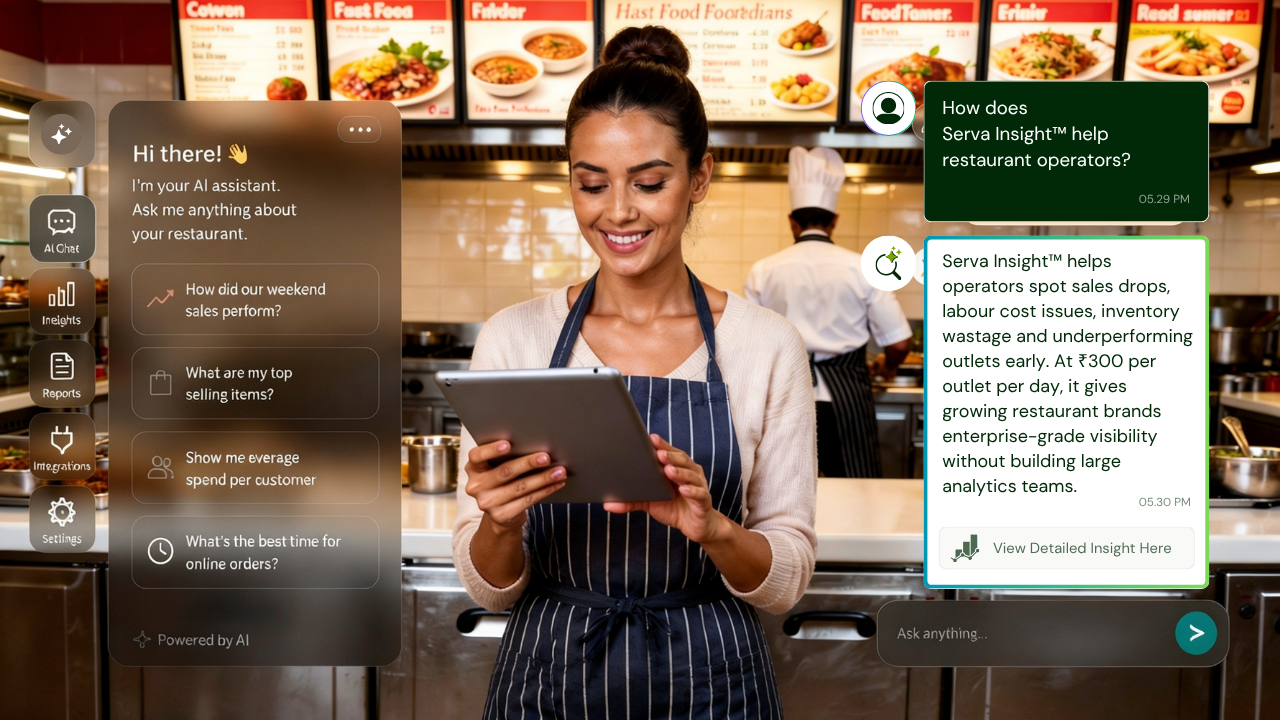
AI changes this by connecting those data sources into a single layer and making it queryable in plain language.
An operations head can ask: which outlet in Mumbai had the highest food wastage rate this week, and is it linked to the new menu addition? The system draws on POS data, inventory records, and waste logs across all outlets and returns a specific, grounded answer.
No analyst. No pivot table. No waiting until Friday.
What AI Cannot Do & Why That Matters
It is worth being equally clear about what AI does not do in this context.
It does not make decisions for the operator. It does not replace the experienced franchise manager who knows that a particular outlet always underperforms during school exam weeks. It does not remove the human judgment that goes into responding to a food cost variance — deciding whether to adjust the portion, the supplier, or the menu.
What it does is remove the information gap between what is happening in the business and what the person responsible for fixing it can see. The decision still belongs to the operator. The intelligence layer simply ensures they are making it with accurate, current information rather than a report from last week.
For India's growing class of mid-market restaurant chains and franchise operators businesses that are too large to manage manually and not yet large enough to justify an in-house analytics team — this is exactly the kind of practical AI application that creates a measurable difference in how a business performs. Not in theory. On the P&L, every month.
Understand how practical AI helps multi-outlet restaurant chains connect operational data, surface actionable insights faster, reduce information gaps, and improve everyday business decisions.



Artificial intelligence has become one of those terms that means everything and nothing at the same time. In restaurant industry conversations, it can refer to anything from robotic kitchen equipment to demand forecasting algorithms to the chatbot on a brand's customer app.
For a restaurant chain or franchise network running 50 or more outlets in India, none of that is the most important AI conversation to be having right now.
The most valuable application of AI for a multi-outlet restaurant operator today is considerably more practical: getting the right operational information to the right person fast enough for them to act on it.
Practical AI Implementations
The challenge most operations teams face is not a shortage of data. It is the time and effort required to make sense of it. Data from POS systems, delivery platforms, labour management tools, and inventory systems sits in separate places, in separate formats, updated at separate times.
Extracting a coherent picture of what is happening across 50 stores on a given Tuesday is either a manual exercise that takes hours or something that simply does not happen between weekly reports.
AI changes this by connecting those data sources into a single layer and making it queryable in plain language.
An operations head can ask: which outlet in Mumbai had the highest food wastage rate this week, and is it linked to the new menu addition? The system draws on POS data, inventory records, and waste logs across all outlets and returns a specific, grounded answer.
No analyst. No pivot table. No waiting until Friday.
What AI Cannot Do & Why That Matters
It is worth being equally clear about what AI does not do in this context.
It does not make decisions for the operator. It does not replace the experienced franchise manager who knows that a particular outlet always underperforms during school exam weeks. It does not remove the human judgment that goes into responding to a food cost variance — deciding whether to adjust the portion, the supplier, or the menu.
What it does is remove the information gap between what is happening in the business and what the person responsible for fixing it can see. The decision still belongs to the operator. The intelligence layer simply ensures they are making it with accurate, current information rather than a report from last week.
For India's growing class of mid-market restaurant chains and franchise operators businesses that are too large to manage manually and not yet large enough to justify an in-house analytics team — this is exactly the kind of practical AI application that creates a measurable difference in how a business performs. Not in theory. On the P&L, every month.